
Think of Abraham.
God called him to Himself, and he responded without hesitation, “Here I am!” (Hineni)! At that moment, he had no idea what God would ask of him. Not much later, however, he did; God asked him to sacrifice his son Isaac! Immediately afterward, we read that Abraham saddled his donkey, called his son and two servants, and “simply” left! 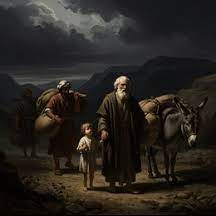
He set out with complete surrender, availability, willingness, and obedience to God. Even though he didn’t know the exact outcome, he did know one thing: who God is and that God is a good God! We can infer this from the text in Genesis 22:5, by what he says to his servants when they arrive at the place where God had appointed to sacrifice his son: “Stay here with the donkey while I and the boy go over there. We will worship and then we will come back to you.”
He knew that God would provide another solution so he wouldn’t have to sacrifice his own son. At that moment, he didn’t yet see how, what, or when, but that didn’t stop him from surrendering and willingly obeying and trusting God and setting out on his journey.
We see another example with Moses.
“When the LORD saw that he had gone over to look, God called to him from within the bush, “Moses! Moses!” And Moses said, “Here I am.” – Exodus 3:4
God calls him to lead the people of Israel out of Egypt (Exodus 3).
He protests fiercely, presents all sorts of arguments, pleads with God, and negotiates with Him to get out of this task. He felt completely incapable of taking on this responsibility. He had an identity crisis; raised as a prince in Egypt but secretly of Hebrew descent, he felt no connection whatsoever with the people he was to lead out of Egypt. Likewise, he feared the people’s reaction, doubted his own worthiness and abilities, and felt he was not eloquent enough. 
Finally, after a series of conversations in which God refuted each of Moses’ excuses and promised him that he had nothing to fear because He would go with him, Moses agreed, obeyed God, and began his journey toward the promised land, with the people of Israel following close behind.
He had no idea how the journey would unfold or what struggles they would face, yet he placed his trust in God: “Here I am, Lord, send me!”
God might not ask you to sacrifice your child as a test to see how you’ll react, and He probably won’t ask you to lead an entire nation, on foot, to another country either, LOL. What He does ask of us is whether we are available at all, whether we are willing to follow Him where He sends us, and to seek out what He does ask of us.
Even though what He might ask might seem illogical, unclear, daunting, or require a great deal of trust on our part, with no idea of the outcome, God longs for us to respond with:
“Hineni! Here I am. Send me!”